What Weight Punching Bag Should I Buy?
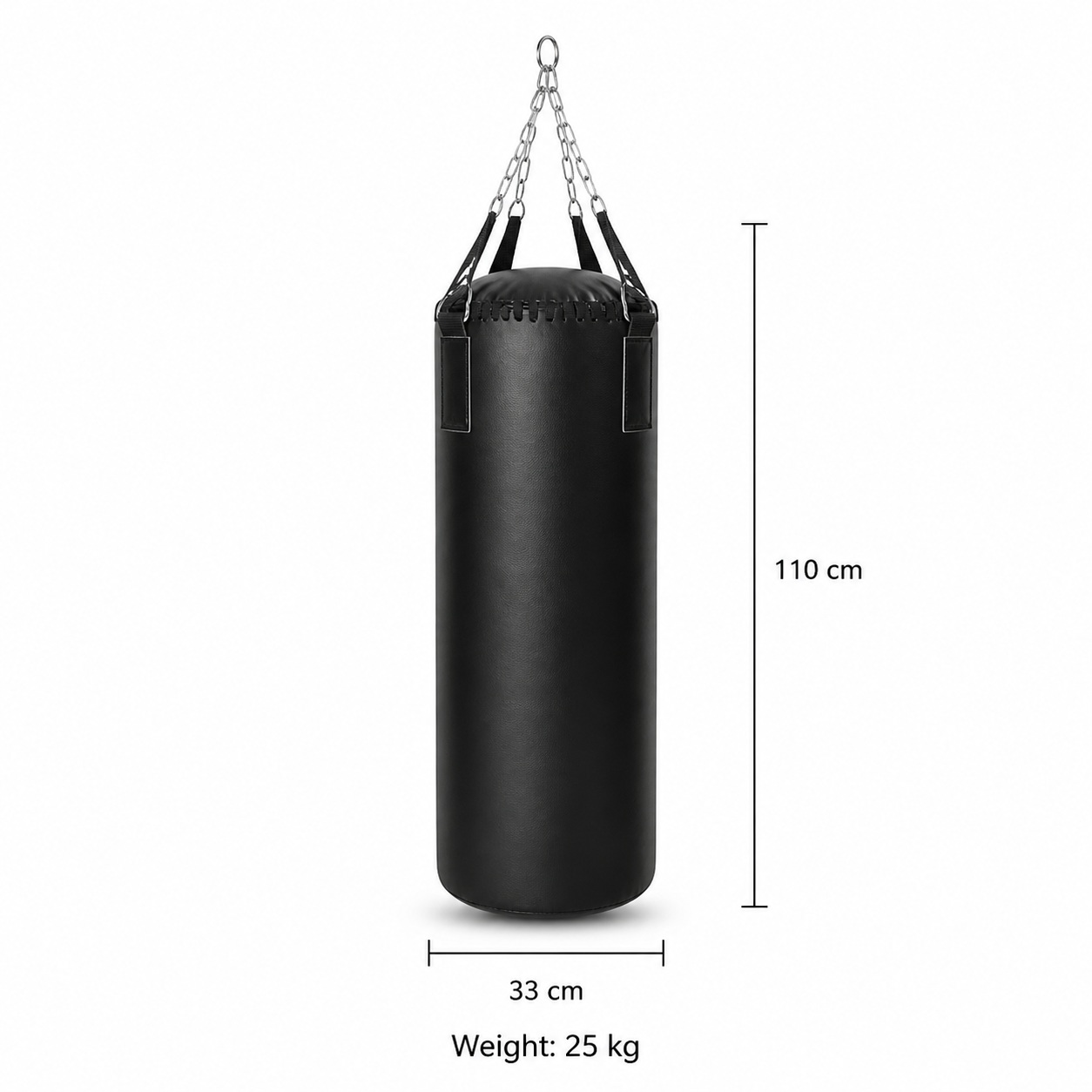
The standard guideline is to choose a punching bag weighing roughly half your bodyweight. Our 25kg hanging bag therefore suits most adults from about 55kg to 85kg. Go lighter if you want speed, movement and combination work; heavier if you want pure power development.
The half-your-bodyweight rule
Pick a bag weighing roughly half what you weigh. That is the guideline every gym uses, and it holds up because it balances two competing problems.
Too light, and the bag folds around your fist and flies away. You cannot develop a punch against something that offers no resistance, and a wildly swinging bag is more annoying than useful. Too heavy, and the bag barely moves. All the energy you put in comes straight back through your wrist, you learn nothing about timing because the target never travels, and your joints take the difference.
At around half your bodyweight the bag absorbs a solid punch without collapsing, and still moves enough to teach you distance.
Sizing table by bodyweight
| Your bodyweight | Ideal bag weight | Does our 25kg bag suit you? |
|---|---|---|
| Under 45kg | ~10–20 kg | Workable, but it will swing a lot |
| 45–55kg | ~22–28 kg | Yes — plenty of movement |
| 55–75kg | ~28–38 kg | Yes — the ideal fit |
| 75–85kg | ~38–42 kg | Yes — swings more, still solid |
| Over 85kg | ~45 kg+ | Usable, but expect a lot of swing |
The rule is a starting point, not a law. Plenty of 90kg people train happily on a 25kg bag because they want movement and combination work rather than pure power. The bag swinging is not a fault — it is feedback.
Why we stock 25kg
We stock a single size, at 110cm and 25kg, because it is the one the overwhelming majority of home buyers end up wanting — and the one that comes back to us least often as "wrong".
Here is the reasoning:
- It covers the widest band of adults. Anyone from roughly 55kg to 85kg lands in the sweet spot, which is most people who walk into the showroom.
- It suits beginners better than a heavier bag. A bag that moves gives honest feedback about your technique, and it is far gentler on wrists that have not adapted to impact yet.
- It fits Singapore homes. At 110cm, plus about 40cm of chain and hook, it needs roughly 1.7m of drop — comfortable under a standard 2.6m ceiling with head room underneath.
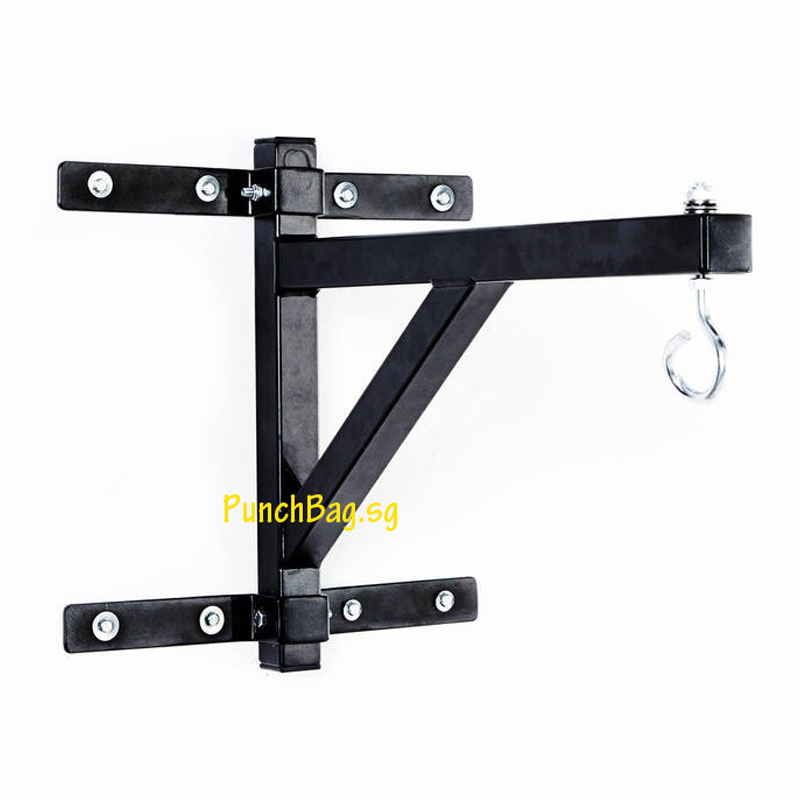
- It stays well inside a bracket's rating. The WM-40 bracket is rated to 100kg, so a 25kg bag sits four times inside its limit. That margin matters, because a swinging bag briefly loads its mount far above its resting weight.
- It is a realistic carry. One person can manage 25kg up a lift and into position. 40kg is a two-person job, and that catches people out.
Stocking one size we can genuinely recommend beats stocking three and letting people guess. If 25kg is wrong for you, we would rather tell you than sell you it.
If you fall outside the range
You are very light, or buying for a child
A 25kg bag will still work — it will simply swing more, which is not dangerous, just lively. If you want something genuinely lighter for a child, talk to us before ordering; a bag that is too heavy for a small person is worth avoiding, and we would rather say so than take the order.
You are heavy, strong, or an experienced striker
You have two sensible options.
- Accept the swing. Many experienced people prefer a lighter bag precisely because it moves — it forces footwork and timing rather than letting you stand and hit.
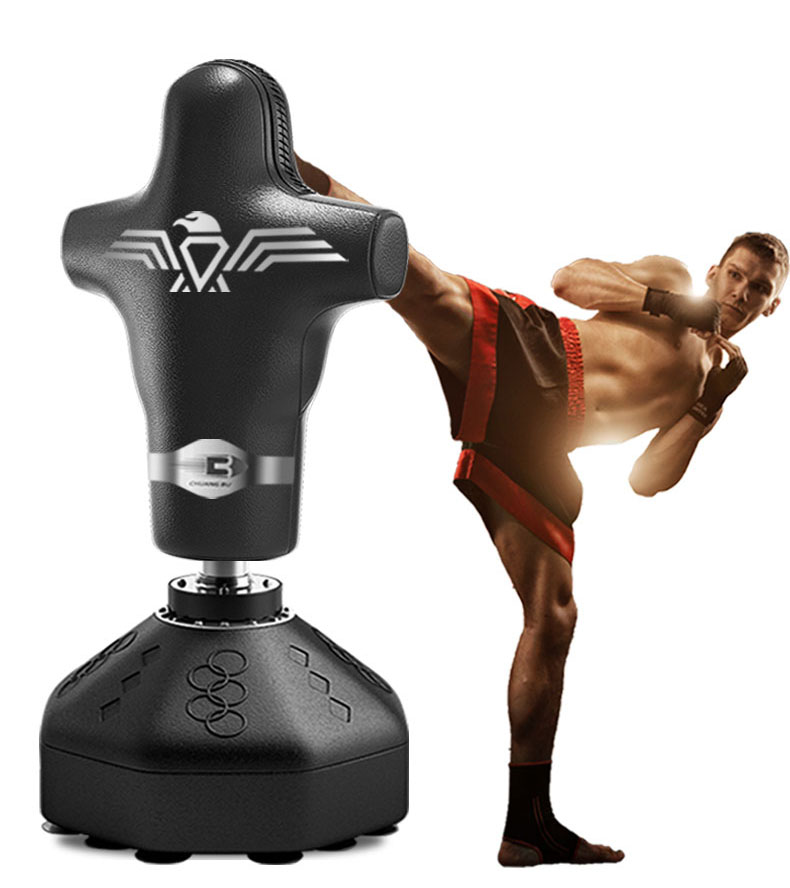
- Consider the standing BOB bag instead. Filled with sand its base reaches around 100kg, and the spring column absorbs heavy shots while returning to centre. For a big, strong striker it often feels more substantial than a 25kg hanging bag.
You mainly throw low kicks
Length matters more than weight here — see the next section. Our 110cm bag handles body kicks well but stops above thigh height, so dedicated low-kick work is not what it is best at. Come and try it before deciding.
Why length matters as much as weight
Weight determines how the bag responds. Length determines what you can hit.
| Strike | Lands on a 110cm bag? | Notes |
|---|---|---|
| Jab, cross, hook | Yes | Head and chest height — ideal |
| Uppercut | Yes | Works well into the lower half of the bag |
| Body shots | Yes | Bend the knees to get down to it |
| Body kicks & knees | Yes | Mid-bag, comfortable range |
| Low kicks (thigh) | Not really | The bag ends above thigh height |
If low kicks are central to your training, say so when you visit and we will be straight with you about whether this bag suits. It is a good boxing and kickboxing bag; it is not a dedicated Muay Thai banana bag.
The two sizing mistakes people make
Assuming heavier is better
There is a persistent belief that a heavier bag means more serious training. It does not — it means less feedback and more joint loading. Beginners in particular learn faster on a bag that moves, because movement tells you whether the punch was any good. A very heavy bag hit badly and hit well look almost identical from where you are standing.
Not measuring the ceiling
The bag plus chain and hook needs about 1.7m of drop, and you want at least 20cm of clearance beneath it. Under a standard 2.6m ceiling that works comfortably. Under a false ceiling, a bulkhead, or in a room with a low beam, it may not. Measure before you order — and remember that in most Singapore flats the bag is going on a wall bracket rather than the ceiling, which changes the geometry.
Tell us your ceiling height and what you train, and we will work out the drop and tell you honestly whether the 25kg bag suits you. It is hanging and ready to hit at Lower Delta Road.
Call +65 6372 1581, email hello@punchbag.sg, or come to the showroom and ask in person. We would rather talk you out of the wrong bag than sell you one.